

Summary: Choosing the right chiropractor in Campbell, CA involves more than finding a nearby clinic. The right provider should match your health needs, treatment goals, preferred care approach, and practical requirements such as availability and communication.
Key Takeaways:
- Identify your specific health concern before comparing chiropractic providers
- Review credentials, licensing, and experience related to your condition
- Compare treatment approaches, communication style, and patient experience
- Consider convenience factors that support long-term consistency with care
- Choose a chiropractor whose expertise aligns with your personal goals
Deciding to see a chiropractor deserves more thought than simply picking the closest clinic or the one with the best reviews. Chiropractic care is highly individualized, and no two patients are exactly alike. The provider best suited to a runner recovering from a knee injury may not be the right choice for an expectant mother or a young child.
For Campbell residents, chiropractic care may begin with back pain, neck tension, an injury, or reduced mobility. But pain is not the only reason someone may choose to see a chiropractor. Some patients are more interested in how well their spine is functioning, maintaining mobility, supporting physical performance, or addressing structural changes before they become more noticeable.
As you compare providers, look beyond location and reviews. Consider their credentials, clinical experience, evaluation process, care philosophy, adjustment methods, and how they measure progress. A chiropractor whose approach matches your longer-term health goals may be a better fit than one chosen based on symptoms alone.
Start With What You Want From Chiropractic Care
Before evaluating any provider, think about what you want from chiropractic care. Some patients are dealing with pain, an injury, or reduced mobility. Others feel well but want to support spinal function, physical performance, posture, or long-term wellness.
Consider:
- Are you currently dealing with pain, stiffness, or an injury?
- Are you looking for short-term symptom relief or a more corrective approach?
- Do you want your chiropractor to evaluate spinal structure as well as symptoms?
- Are mobility, athletic performance, posture, or long-term spinal health part of your goals?
- Do you have specialized needs, such as prenatal, pediatric, or sports-related care?
The more clearly you define your goals, the easier it becomes to compare providers. The best chiropractor in Campbell, CA should offer an approach aligned with both your current needs and what you want from care over time.
| Quick Answer: The best chiropractor for you should match both your current needs and your longer-term health goals. Pay attention to how each provider evaluates the spine, develops care recommendations, measures progress, and explains the reason behind each adjustment. |
Look at the Chiropractor’s Philosophy of Care
Chiropractic offices do not all operate under the same philosophy.
Some practices primarily work with musculoskeletal complaints such as back pain, neck pain, stiffness, and injuries. Visits may be centered around reducing symptoms and helping the patient return to normal activity.
A spinal corrective care practice takes a broader structural view. Rather than looking only at where a patient hurts, the chiropractor evaluates the structure and function of the spine and uses those findings to guide care.
For patients, asking about care philosophy can reveal more than a long list of conditions on a website.
Research Top Chiropractors Serving Campbell, CA
Once your needs are clear, begin developing a list of prospective providers. A local search will identify chiropractors serving Campbell and nearby areas like San Jose, Los Gatos, and Saratoga. Look beyond the map pin and study each result.
Assess the services offered and conditions treated to determine whether they align with your concern. Review the practitioner’s information to understand each provider’s background. Confirm the location and service area to make sure the practice serves your community.
From there, develop an initial shortlist of a few providers worth closer consideration. Narrowing your focus at this stage keeps the comparison manageable and productive.
Location Alone Should Not Determine Your Choice
While accessibility is important, it should not be the deciding factor. The nearest office is not necessarily the most appropriate one for your needs.
Weigh relevant expertise, treatment philosophy, available services, and patient experience alongside location. Regard convenience as one consideration among several, rather than the primary criterion. A modestly longer commute to a provider who genuinely meets your needs is usually a worthwhile trade-off.
| Common Mistake: A common mistake is choosing a chiropractor only because the clinic is closest to home or work. Convenience matters, but provider expertise and treatment compatibility often have a greater impact on your overall care experience. |
Look Into Credentials and Clinical Experience
Credentials indicate whether a chiropractor is qualified; experience indicates whether they are well-suited to address your particular concern.
Begin with the fundamentals: verified education and chiropractic credentials, along with current state licensing. Then consider their broader professional experience and, more specifically, their relevant treatment experience.
A demonstrated commitment to continuing education is another positive indicator: it shows the provider stays current with evolving techniques and clinical research.
Above all, seek experience with your specific concern. General experience is valuable, but targeted experience is preferable.
Match Clinical Experience to Your Health Concern
When reviewing a provider’s background, look for alignment with your particular need:
- Sports injuries: experience with active patients and rehabilitation
- Auto injuries and whiplash: familiarity with accident-related trauma
- Spine-related concerns: expertise in conditions such as herniated discs and sciatica
- Pediatric care: training in gentle techniques appropriate for children
- Prenatal care: experience supporting expectant mothers
Alignment in this area can meaningfully influence the quality of your outcomes.
Compare Treatment Approaches and Available Options
Two chiropractors with comparable credentials may practice quite differently. For this reason, it is worthwhile to compare how each provider provides care.
Look for a chiropractor who begins with a thorough initial assessment and develops a personalized care plan rather than applying a standardized protocol to every patient. Clear communication and patient education are essential; you should understand both your condition and the rationale behind your recommended care.
Consider the treatment techniques offered, the approach to progress monitoring, and the overall range of available services. At Chiropractic First, care includes gentle, precise, specific spinal adjustments, usually performed by hand, with the goal of helping restore more normal spinal function. Recommendations are based on the patient’s examination and spinal findings rather than symptoms alone.
| Watch Out: Be cautious of clinics that recommend the same treatment plan for every patient without first understanding your symptoms, health history, and goals. |
Assess the New-Patient Experience
The first appointment provides valuable insight into how a practice operates. A thorough new-patient experience should include a detailed consultation, examination, and a clear explanation of any findings before care begins.
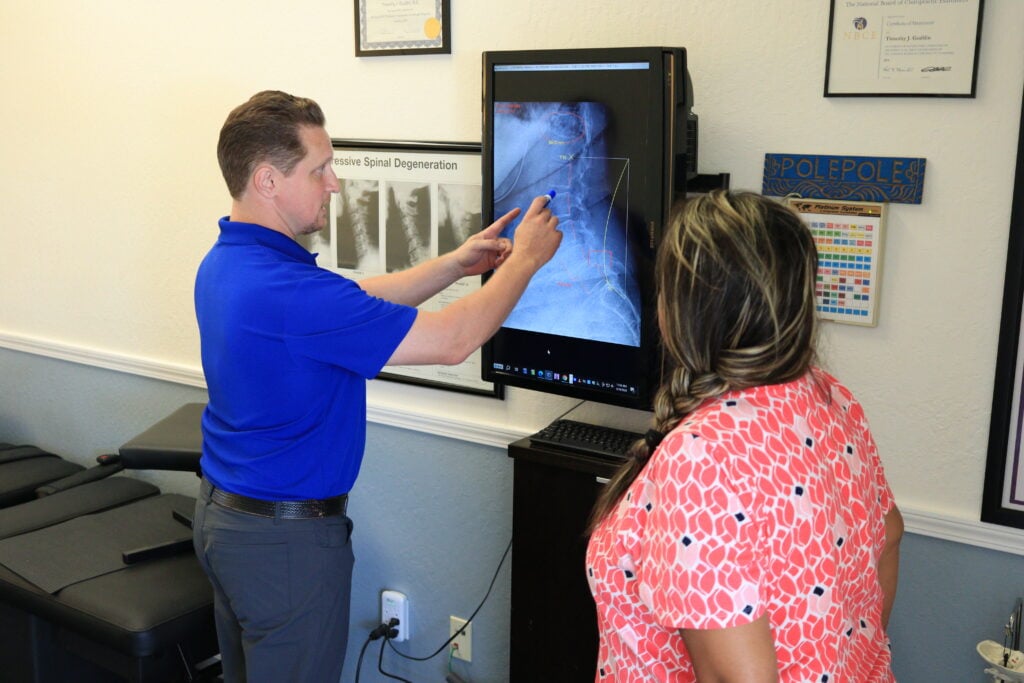
It is also worth asking how the chiropractor evaluates spinal structure. At Chiropractic First, spinal X-rays are part of the standard pre-care process. These images give the doctor more information about spinal alignment, structural changes, previous injuries, and other findings before recommending a corrective care plan.
You should leave the evaluation with a clear sense of what the chiropractor found, why care is being recommended, and how progress will be evaluated.
A practice that rushes through the initial assessment without explaining its findings may not provide the level of detail you want from ongoing care.
Questions Worth Asking Before Beginning Care
Before committing to a provider, consider asking:
- What will my first appointment involve?
- How will my treatment plan be determined?
- Which techniques may be appropriate for my condition?
- How will my progress be evaluated?
- What costs or insurance considerations should I be aware of?
The responses will reveal a great deal about a provider’s transparency, approach, and suitability.
| Next Step: Write down your top health concerns and questions before your first consultation. This helps you compare providers more effectively and make a more informed decision. |
Read Reviews With a Discerning Eye
Patient reviews can be informative, provided they are interpreted thoughtfully. Rather than focusing on a single star rating, account for the overall patient sentiment and the broader picture it presents.
Note recurring observations about communication, feedback regarding staff and office experience, and comments on the quality of patient care. Reviews from patients with needs similar to your own are particularly relevant.
Also consider the recency and consistency of the feedback: a sustained pattern of positive experiences is more meaningful than an isolated outlier.
Consider Practical Factors That Support Ongoing Care
Chiropractic care frequently involves multiple visits, so practical considerations carry genuine weight over time. As you compare providers, take into account:
- Location and ease of access
- Office hours compatible with your schedule
- Appointment availability, including weekend availability
- Communication options for scheduling and inquiries
- Insurance and payment considerations
- The ease of maintaining appointments over the course of treatment
A practice that integrates comfortably into your routine makes it considerably easier to remain consistent, which, in turn, can help support consistency and progress during care.
Why Chiropractic First May Warrant Consideration
As you develop your comparison, Chiropractic First in Campbell, CA is one local practice worth evaluating against your criteria.
Our practice offers a convenient Campbell location, a personalized approach to care, and a comprehensive range of chiropractic services. We provide care for diverse patient groups and follow a structured new-patient process designed to understand each patient’s needs before recommending treatment. A variety of relevant treatment options are available to address a range of concerns.
Rather than accepting any single claim at face value, we encourage you to evaluate Chiropractic First against your own criteria. The most suitable chiropractor is the one that best aligns with your individual needs, so we invite you to measure every option against the framework outlined above.
| Key Takeaway: A strong chiropractor-patient relationship is built on communication, trust, and a treatment approach that matches your specific health goals. |
Making Your Decision With Confidence
Choosing the best chiropractor in Campbell, CA ultimately comes down to alignment. For some patients, pain relief is the main priority. Others may want a chiropractor who evaluates spinal structure, tracks corrective progress, and supports long-term function even when no current pain is present.
When you match your specific health needs with a provider’s expertise, treatment approach, and patient experience, while accounting for practical considerations, you position yourself for more effective care and better outcomes.
Take the time to evaluate your options carefully, ask informed questions, and rely on a clear framework. When you are ready, consider scheduling a consultation with Chiropractic First to determine how their approach aligns with your needs.
Frequently Asked Questions (FAQs)
1. How do I find the best chiropractor in Campbell, CA for my condition?
- Begin by identifying what you want from chiropractic care, whether that is addressing pain or injury, improving spinal function, supporting physical performance, or taking a more corrective approach. Then compare credentials, evaluation methods, care philosophy, patient reviews, and practical factors such as location and hours.
2. What qualifications should a reputable chiropractor have?
- Look for appropriate chiropractic education, current state licensing, and clinical experience, ideally with your particular concern. Ongoing continuing education is a strong indication that the provider remains current with modern techniques.
3. What questions should I ask a chiropractor before my first visit?
- Ask what the initial appointment involves, how your treatment plan will be developed, which techniques may be appropriate for your condition, how progress will be measured, and what costs or insurance considerations apply.
4. Is it worth selecting a chiropractor farther away for greater expertise?
- In many cases, yes. While convenience is a valid consideration, relevant expertise and an appropriate treatment approach typically have a greater impact on outcomes than proximity alone.
5. How can I determine whether online reviews for a chiropractor are reliable?
- Look beyond the star rating for recurring themes, feedback from patients with similar needs, and consistent, recent commentary. A sustained pattern is more dependable than any single review.
6. Can one chiropractor address different needs, such as sports injuries and prenatal care?
- Some practices offer a broad range of services and treat multiple patient groups. Confirm that the provider has specific experience with your concern rather than assuming that general experience is sufficient.
7. Should I see a chiropractor even if I am not in pain?
- Some patients seek chiropractic care even without current pain because they are interested in spinal function, mobility, posture, physical performance, or long-term wellness. A spinal evaluation can provide more information about structural findings that may not currently be causing noticeable symptoms.